Stiff thumbs, a weaker grip, tired eyes. Here is exactly which gun and which load fit the hands you have now, which best-sellers to walk past, and what you should pay. Named guns. Named loads. Real prices.
You are at the counter. The young man behind the glass hands you the pistol everybody buys. You take hold of the slide and pull. It does not move. He is watching. Nobody over sixty likes to say "I cannot pull that back" in front of a stranger, so you nod, and you pay, and the mismatch goes home in a paper bag.
Maybe you have said one of these yourself:
I am Ray Bennett. I have watched a seventy-four-year-old man buy a pistol he could not load. It lived in his nightstand unloaded, and he never told his wife. I have watched a couple in their seventies handed a featherweight magnum revolver. He fired it five times, she fired it once, and it has been in a sock drawer ever since.
None of them were foolish. Each one was sold a gun built for a thirty-year-old's hands by someone who never asked about theirs.
The clerk is not a villain. He has strong hands, he shoots every week, and he sells what works for him. So I wrote down the advice those people should have had before they paid. Which guns passed in older hands. Which ones failed, by name. What goes in each one. And what it should cost you at the door.
Most people rack a slide the hard way. They hold the gun out in front and pull the slide back with a thumb and a finger. That uses the weakest muscles you have. Do it this way instead.
You are pushing with your chest and shoulder and holding with your whole hand. People who could not budge a slide the old way run it easily like this.
That is one page. The book is 130.
The price on the tag is only the start of what a wrong gun costs you.
A Springfield Hellcat or a Sig Sauer P365. Trade it back and the shop gives you roughly half to two thirds of its value.
A Smith and Wesson 340 PD. Fired six times, then the sock drawer.
I watched a man walk in for a four-hundred-dollar pistol and leave seven hundred fifty dollars lighter. Sold one more thing, six times.
A man carried one load for nine years on the clerk's word. I shot it into a test block. The deepest round stopped at eight and a half inches.
The gun that passes, the load that goes in it, the fair price, and what to refuse at the register.
And the gun I recommend most, the Smith and Wesson M&P 380 Shield EZ, is a fair buy at $380 to $450. The first choice in the book costs no more than the guns that fail.
These are real pages from the book. No filler. Names, loads and numbers.
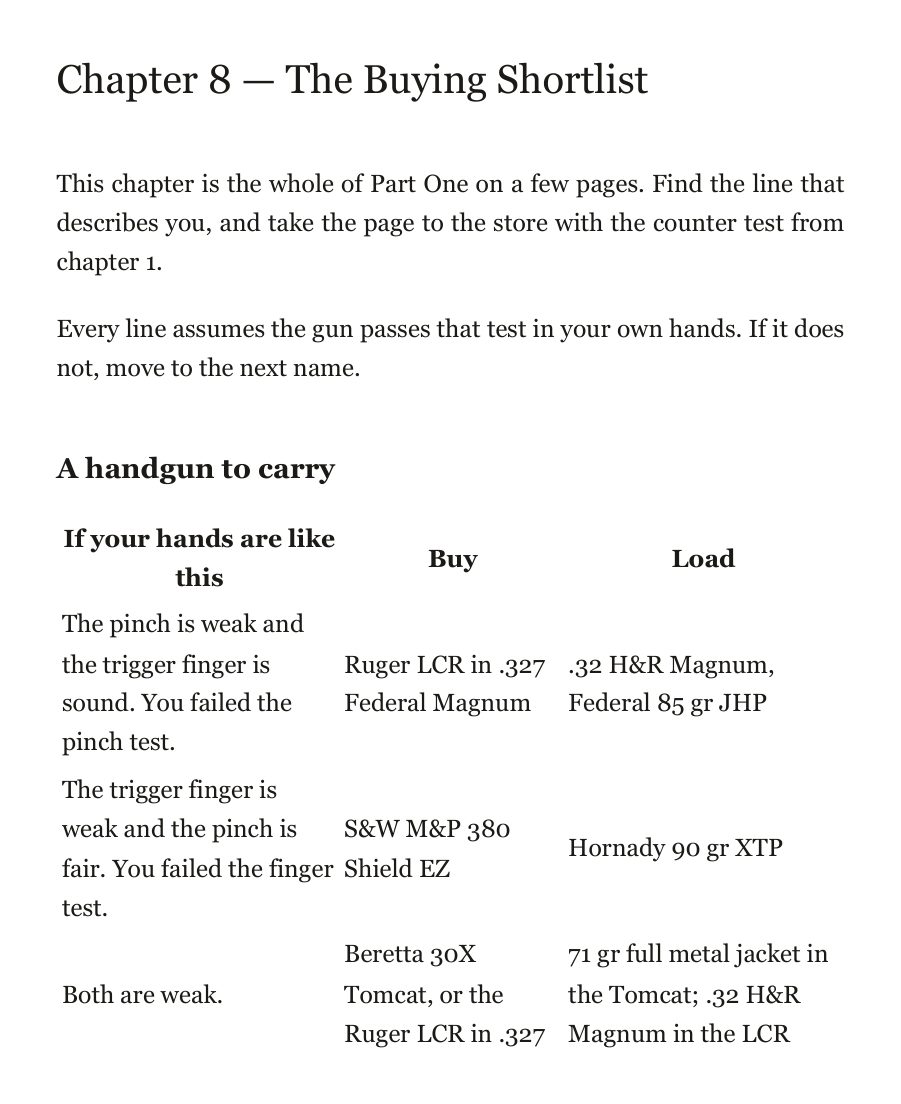
Weak pinch. Weak trigger finger. Both. Strong hands and tired eyes. Find your line and you have the gun and the load, for carry, for the nightstand and for a long gun. Plus a list by budget, from about $250 up.
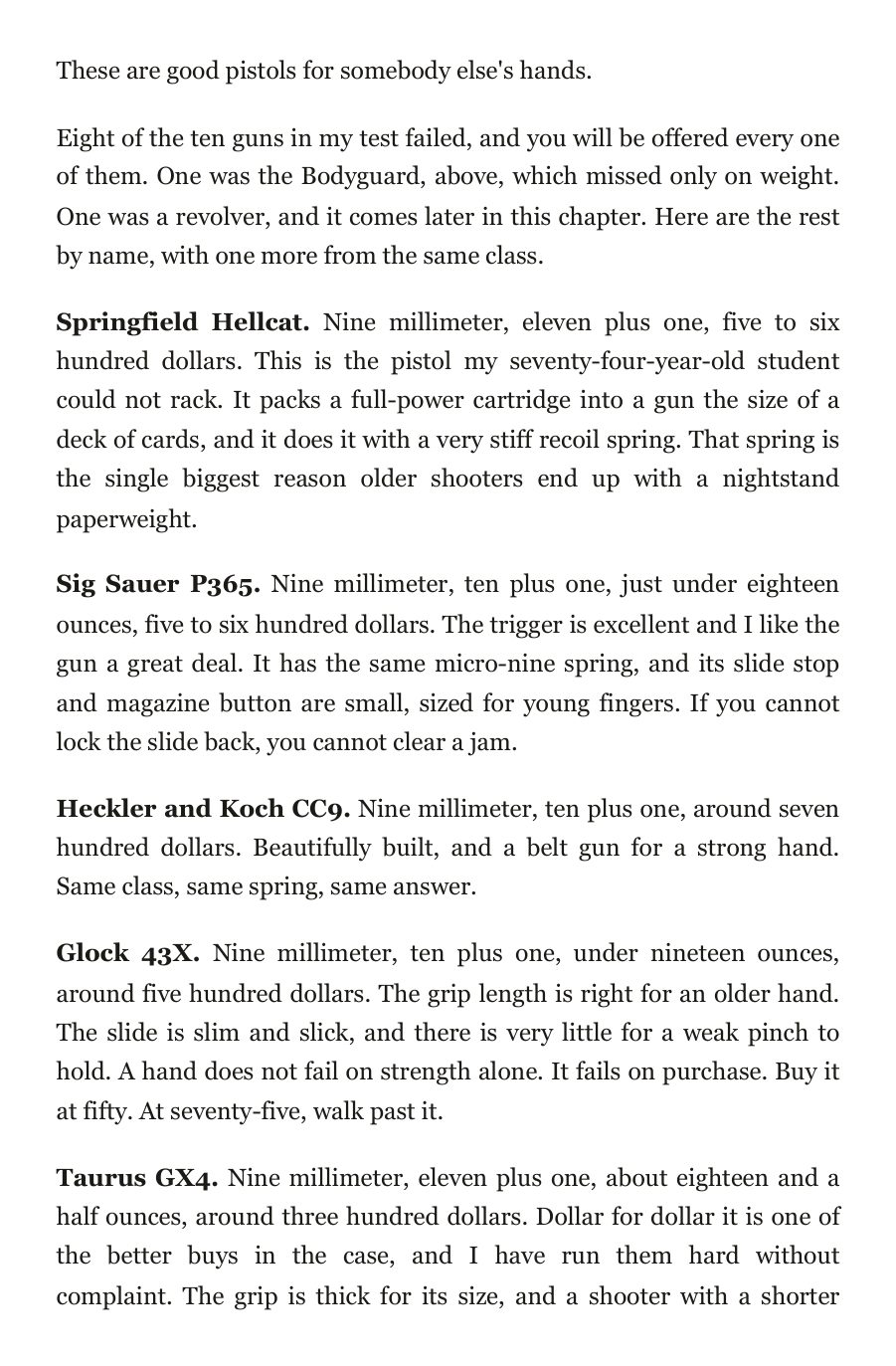
I ran ten popular carry pistols past older shooters. Eight failed. Then ten revolvers, with four shooters aged sixty-nine to eighty-three and a gauge on every trigger. Three passed. You get every name and the reason, including the most recommended "senior gun" in America and why it is the worst advice in the business.
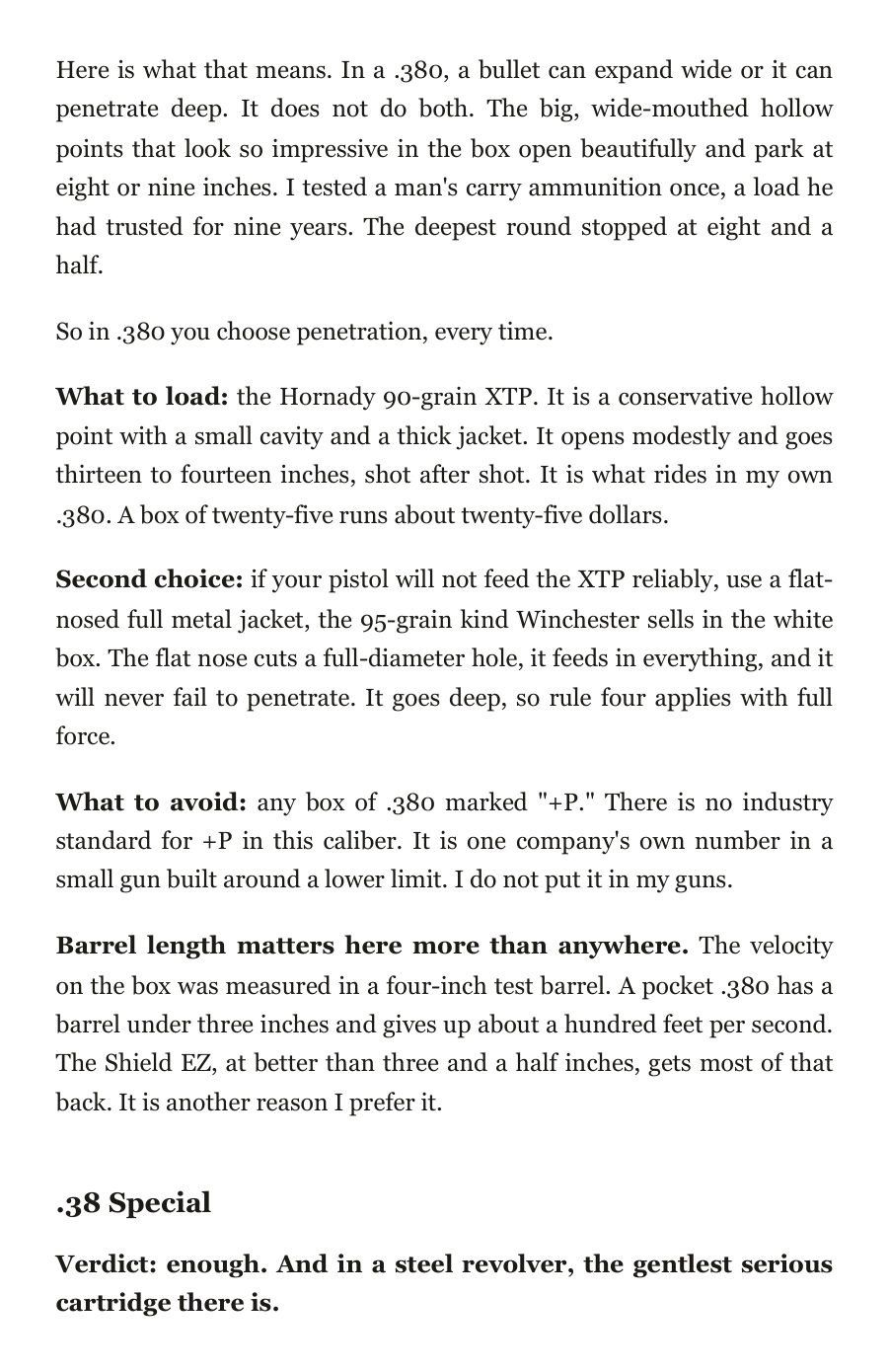
.22, .32, .380, .38 Special, 9mm, .410, 20 gauge and 12 gauge, each one settled plainly. In a .380 it is the Hornady 90-grain XTP. In a .38 revolver it is the 148-grain target wadcutter. Then the 200 plus 50 test that proves a load feeds in your own gun, so you stop living with a picky pistol.
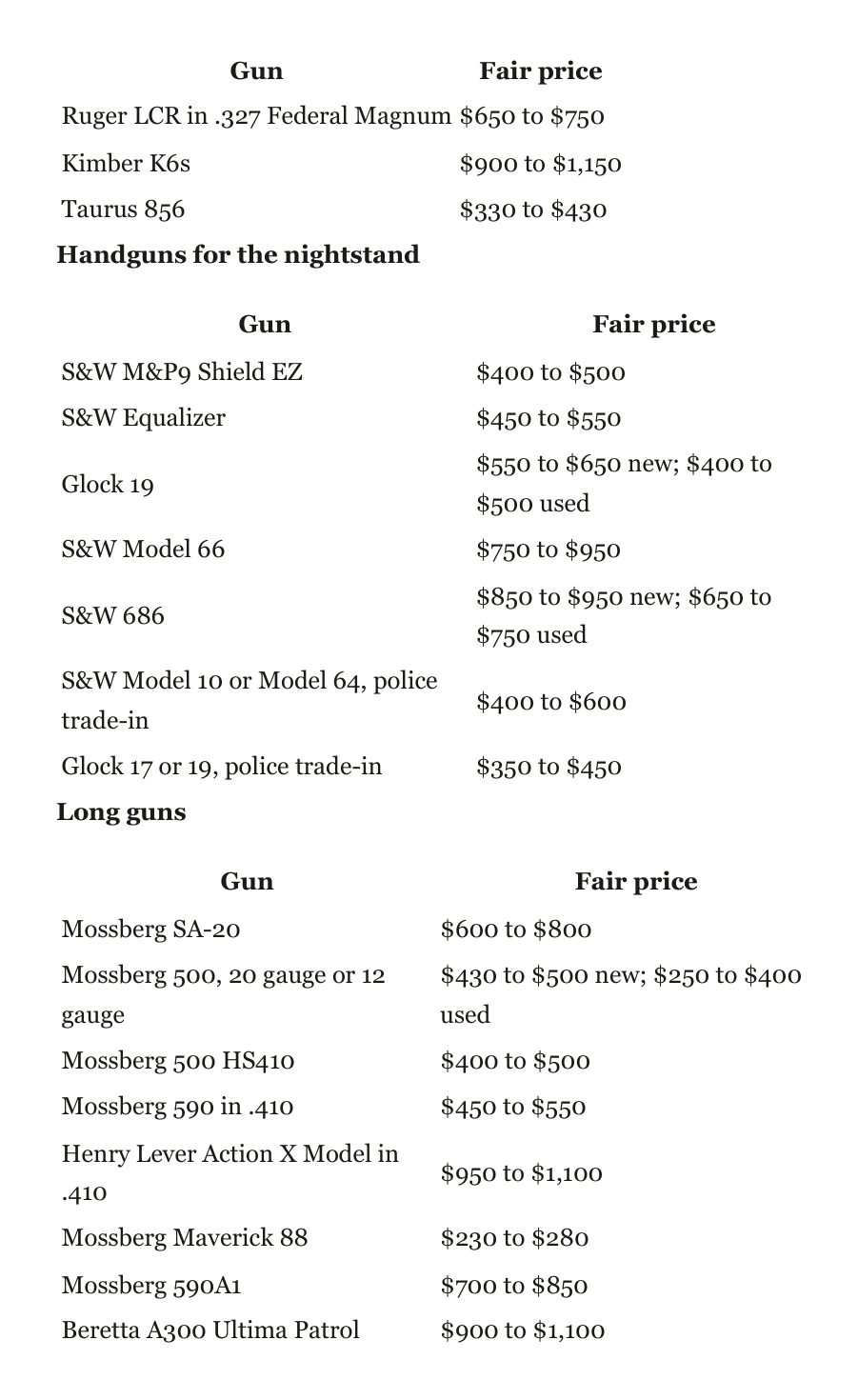
New and used. Police trade-ins at $350 to $450. What to buy used without worry and what to buy new. The sixteen-point used-gun check. What the counter adds at the register and what I say to each. And the one question that brings every charge into the open: "What is it out the door?"
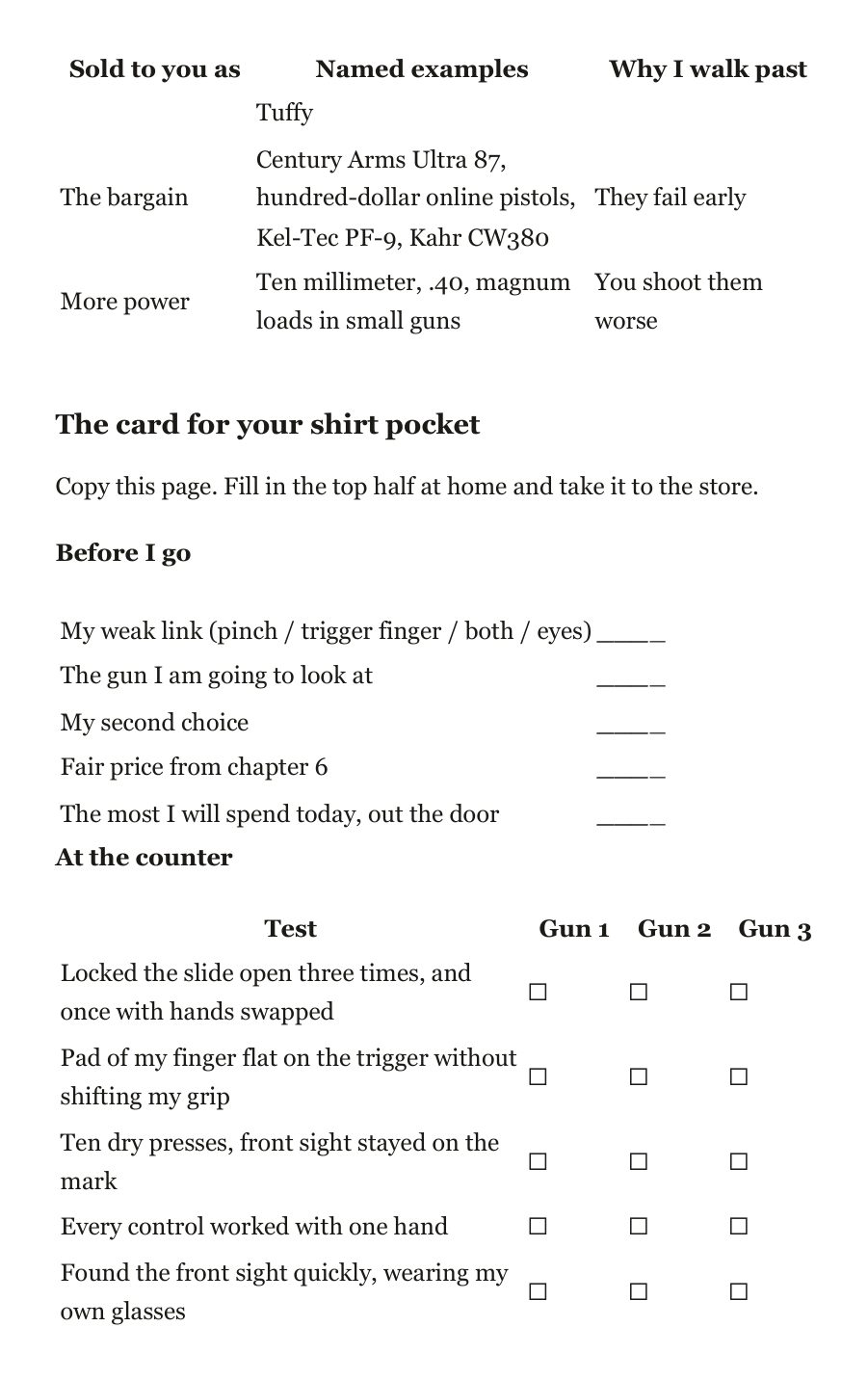
Three two-minute tests at home find your weak link: pinch, trigger finger or eyes. Then the six-step counter test goes to the store with you on one page, with your top price written on it, three things to say, and when to walk away.
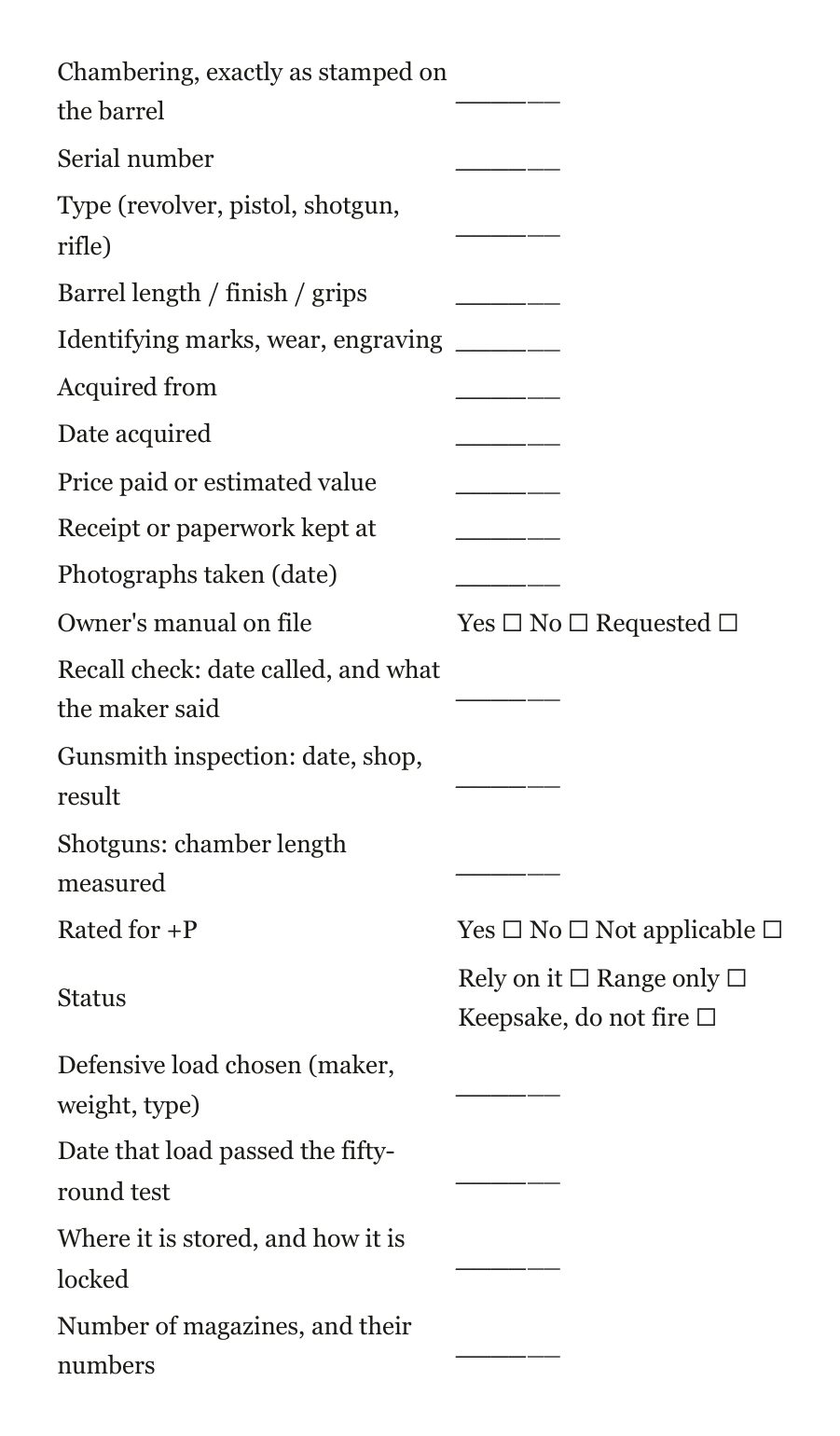
Is it still the right gun for your hands. The ten-minute function check. The gun that sat for twenty years. The inherited gun: look-alike cartridges, Damascus barrels, short chambers. A grip, a front sight and a loader come to about a hundred fifty dollars. Plus nine printable sheets you fill in with a pen.
I am Ray Bennett, a former security and protection officer who now helps ordinary gun owners, most of them my own age or older.
On a protective detail nobody carried the gun he liked. He carried the gun that ran, in the hands he had, on the worst day. That is a different standard from the one used at a gun counter, and it is the standard in this book.
Where I give a trigger weight, it is from my own gauge on my own gun. Where I name a gun to walk past, I tell you why.

Ray Bennett · 130-page PDF · reads on any phone, tablet or computer
Your judgment has not changed and your nerve has not changed. Three physical things have: grip strength, the trigger finger, and the eyes. This book is about those three.
You get my own gauge readings. The Ruger LCR in .327 measured nine and a quarter pounds. The Airweight most counters push runs about twelve, on a gun that weighs under a pound. Forty years of shooting did not put those numbers in your head, and no clerk is going to.
You are exactly who I wrote it for. My student who could not rack his pistol was seventy-four with arthritis in both thumbs.
Run the pinch test and the finger test at home. If the slide is your problem, there is a pistol with a barrel that tips up, the Beretta 30X Tomcat, so you never rack a slide at all. I have watched shooters in their eighties rack a Shield EZ one-handed off a belt. If both hands are bad, there are two guns for that, and I name them.
Then start at chapter 7. Run the counter test on the gun you own. Do the ten-minute function check. Find out whether it has been recalled. Often the answer is not a new gun. It is a grip, a front sight and a loader for about a hundred fifty dollars.
And if the gun fails your hands, the book tells you how to trade out of it and what to buy instead.
No. It is a PDF, 130 pages. It opens on your phone, tablet or computer, and you can make the type as large as you like.
The counter card and the Print Pack sheets are made to be printed at home and filled in with a pen.
Press any Buy button on this page. Pay once on the secure checkout. The page that opens right after you pay has your download button. No account to set up, no password to remember.
You do not need to be. Three taps: Buy, pay with your card, then Download. The book opens on the screen the way a photo does. Spread two fingers on the page to make the words bigger.
One wrong gun costs hundreds and ends up in a drawer. This is the list you take to the store instead.
Buy the guide — $27Instant PDF. Read it tonight.